|
Leaders in Distribution Research, Education and Solutions
|
|
|
Home »
Consortiums »
Sales & Marketing Optimization
Optimizing Sales Force Activities and Marketing Effectiveness
Motivation
Marketing is an underdeveloped science for most distributors. Few distributors
seem to have a consistent, well thought out message that tells who they are
and what makes them different from their competition. Most distributors rely
heavily on their sales force to market their firm. Without common direction the
message is often inconsistent and may, at times, be inaccurate. Here are some
questions that merit consideration:
- What should marketing look like in a distributor’s operation?
- Who should be responsible for marketing?
- What should the message be?
- How should the message be delivered?
- How should the sales force be involved?
Simply put, the marketing message is the story of who we are and why our
customers should want to do business with us. Once the story is created, there
are different mechanisms for its delivery. One well-known vehicle is the brand.
The brand conveys information to the customer about the quality of our
products and services and past experiences they have shared with our firm.
The brand is often supported by advertising (another delivery vehicle for the
marketing story) which further defines our message. For wholesale distributors,
the principle delivery mechanism is the sales force. A sales force without a
powerful marketing message is, in many ways, unarmed when they try to
convey our story to the customer.
A company’s sales force is one of its most significant assets. The value created
by the sales force is key to the success of the firm. While most firms put a
great deal of emphasis on total output from the sales force, most do not
understand how to direct the sales force on a path optimal to the firm’s
profitability. The sales force makes decisions on a regular basis as to what
customers to approach, how to serve those customers, and how to maintain a
positive relationship with customer firms. They do not, however, always know if
their decisions are optimal for their firm and supply chain. Although most
companies monitor and make efforts to control sales force activities, few
companies have a formal means of optimizing sales force activities. Here are
some questions that merit consideration:
- Which sales force activities provide the greatest return on time and
dollars invested?
- Are the efforts of the sales force directed toward activities that provide
the most value to present and future customers?
- Are the efforts of the sales force directed toward present and future
customers that represent the greatest potential for maximizing revenues
and gross margins?
- What are these activities, how can they be identified, how can they be
presented to salespeople?
- How can the firm follow up and measure the effectiveness of these
activities?
- What forms of compensation will motivate the sales force to pursue
optimal profitability in customer relationships?
Deliverables
Consortium members will participate directly in the research and gain a better
understanding of the findings. The full report will be issued to each consortium
member with all analysis performed on the firm itself with the firm’s data. Direct
recommendations will be made for each individual participant firm on:
- A marketing strategy for achieving the most profitable customer
relationships.
- Application of best practices in sales force compensation.
- A customer stratification tool for the firm with recommendations on how
to improve customer relationships and profitability.
- Analysis of current customer service for customer types and programs
(Vendor Managed Inventory, Integrated Supply, etc) and their affect on
profitability.
- Techniques for managing marketing and sales activities through the
customer sales efforts.
- Twenty free seats in the education sessions to follow the consortium.
- All tools created to complete the study and analysis for the study.
All consortium member results and data shared with researchers will be kept
confidential. Only general findings and best practices will be shared with other
consortium members. Distributors will benefit from the research findings and
from sharing best practices with other cutting edge firms in the consortium.
Manufacturers will benefit from shared study with the distribution community.
Solution Approach
Complex relationships (customer, supplier, inventory) make up distributor
success. The key to optimal success is determining how to blend the
distributor’s offering to meet the market most profitably and help the sales force
to drive the right kind of business to get us there.
Click here for bigger image
The graphic depicts that “business we want to do” comes from our core
customers and those customers most easily converted to the core. The sales
force’s efforts should be directed at advancing the core customer business.
The “business we have to do” is stressful and not very profitable but
contributes greatly to sales. The sales force needs to direct the customer to
behavioral changes that will drive them to the core. The “business we don’t
want to do” is the low volume, low profitability, high service type that the sales
force should seek to convert to better business or eliminate.
The supplier plays an important role as well. While it is possible for the
distributors to gain control over customers with products not controlled by
suppliers (low brand equity, many competing offerings), as seen in the
Distributor-Controlled area, it is rarely sustainable. The Vendor-Controlled area
favors the supplier over the distributor and can best be described as “business
we have to do.” The Out of Control zone does not benefit either. So the sales
force’s activities and the distributor’s marketing efforts should be directed at the
Strategic Partner zone as clearly “business we want to do.”
Click here for bigger image
The sales force has to be motivated correctly through the right training and
compensation plans. The actions of the sales force in terms of deployment of
effort, market selection, service deployment, etc has to be thoroughly planned
and understood by all. The market must be thoroughly researched and the right
marketing message designed for the sales force to deliver.
The process has obvious implications for information technology programs
especially those in the Business Intelligence arena. Ultimately the analysis
must deal with one of the most significant constraints faced by all firms: the
time and mindshare of its sales force. Before companies can effectively direct
the efforts of their sales forces toward activities that provide the greatest return
on time and money invested, plus provide the most value to their customers,
companies must first identify these “high value” activities. The identification of
these activities, coupled with the importance of each of these activities
respective to specific situations, is the key to Sales Force Optimization.
The consortium will address these classic sales and marketing issues but will
address them in the context of how marketing supports and directs the sales
force’s actions and how the sales force delivers and redefines the marketing
message. The intent is to create a combination strategy that optimizes the
activities of our overstressed sales force and supports that optimal approach
with a marketing plan that provides a direction and support for their efforts.
Click here for bigger image
Methodologies
Directing the activities of the sales force has traditionally been based on
informal methods of identifying best practices and promoting these practices
among members of the sales force. Examples of activities that are normally the
focus of these traditional methods include: cold calls (which is not part of this
program), appointments, proposals, reports, complaints, meetings,
compensation, training and expenses. In an effort to develop and maintain a
competitive advantage in today’s business environment, this is often not
enough. However, it is important to understand and develop scientific sales
force optimization models and strategies using multiple decision
criteria/variables such as account analysis, best practice compensation
models, customer needs assessment, analysis of the industry and
environment, analysis of the competition, documentation of cost savings, and
total cost of ownership (TCO).
Even though many distributors may be somewhat familiar with these concepts
and may utilize them to some extent, understanding and implementing a
holistic approach to sales force optimization has been achieved by only a
select few. The development of tools that will enhance the scientific decision
making capabilities of sales organizations and backing/directing those
decisions through effective marketing is the most promising step toward Sales
and Marketing Optimization.
The key project steps are:
- The Texas A&M research team will conduct a survey of current
distribution sales and marketing activities across wholesale vertical
marketing channels and conduct ad hoc research to determine best
practices in distributor sales and marketing programs.
- The first consortium meeting will bring together member firms to report
initial results, share best practices, and engage member firms in the
research findings and define final deliverables with counsel from the
consortium members.
-
Through a series of research workshops with member firms and ad hoc
research the research team will:
- Conduct quantitative and qualitative research to identify those
activities most commonly engaged in by distribution sales and
marketing programs with a comparison to support from analysis
programs.
- Conduct quantitative and qualitative research to identify and
develop “best practice” distribution sales force and supporting
marketing activities.
- Quantify the impact of these sales force activities and marketing
support identified above and develop methods to incorporate them
into a Sales and Marketing Optimization model that can be driven
through robust analysis programs based on data and information
routinely absorbed by the firm.
- Develop a scientific model to determine the optimum combination of
sales force and marketing activities given specific situations.
- Develop IT based tools that demonstrate the methods developed.
- Develop an analysis methodology to determine the return on time
and dollars invested in sales and marketing force best practices.
- Develop an analysis methodology to determine the value to
customers of the firm’s sales force and marketing activities.
- Develop new Best Practices in Sales and Marketing Optimization.
- Develop metrics to monitor and improve sales force performance.
-
Develop sales force compensation best practices and quantify their
impact on sales and marketing success.
- The final consortium meeting will share results and capture final
feedback and thoughts from member firms.
- Member firms will receive a final report detailing tools and methodologies
personalized to their environment based on data and scenarios shared
and created in the workshop sessions. These findings are confidential to
the member firm.
- Texas A&M University will present a series of education sessions on
Sales and Marketing Optimization for which consortium members will
receive upto 20 free seats.
Value to Members
The consortium members will receive results, methodology and tools
developed during this pioneering research in Sales and Marketing
Optimization.
- Competitive Advantage
The key advantage for distributors and manufactures would be to gain
competitive advantage by implementing the scientific Sales and
Marketing Optimization methods or using the tools developed to
maximize the results of sales and marketing activity.
- Knowledge
The key advantage to technology companies will be to gain the
knowledge base, methods and tools that can be implemented in their
systems.
- Education
Apart from shaping the research focus and gaining valuable knowledge
base, methodology and tools, each consortium member will be able to
send up to a total of 20 people to three educational sessions that will be
developed from this research. The educational sessions alone represent
a $40,000 value.
Schedule
June 2008 – February 2009: Membership Enrollment & Consortium Formation
March – October 2009: Conduct Research and Develop Tools
November 2009: Develop Educational Program
December 2009 – Dec 2010: Deliver Three Educational Programs
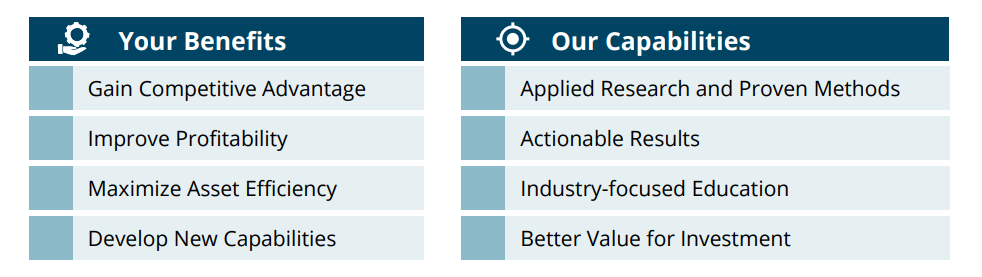
What are the Benefits?
The consortium members will have the exclusive opportunity to:
-
Actively participate in ground-breaking research on one of the most crucial and timely challenges
facing the industry.
-
Direct the scope of the research so that the results are actionable and sustainable.
- Send up to 20 people from their organization at no cost to the educational programs that will follow
the research study**.
The membership fee is $25,000 per company in the consortium. This fee will cover attendance in
consortium meetings, company-specific workshops, and upto 20 free seats** in the educational programs.
All these meetings/conferences will be hosted by Texas A&M University at College Station, TX.
** Free seats valid for 3 educational sessions to be conducted within 1 year after the consortium study.
For more information or to Join the Research Consortium
please contact:
F. Barry Lawrence, Ph.D.
Harvey Hubbell Professor in Industrial Distribution,
Program Coordinator, Industrial Distribution Program,
Director, Thomas & Joan Read Center for
Distribution Research and Education,
Director, Supply Chain Systems Laboratory.
3367 TAMU, Texas A&M University,
College Station, TX 77843-3367
Office : (979) 845-1463
Mobile : (979) 574-4178
Fax : (979) 845-4980
E-Mail : lawrence@entc.tamu.edu
Norm Clark
Associate Director,
Thomas & Joan Read Center for
Distribution Research and Education,
3367 TAMU, Texas A&M University,
College Station, TX 77843-3367
Office : 203E Fermier Hall
Mobile : (979) 847-9076
E-Mail : clark@entc.tamu.edu
|
|
|
|